The one-minute read
The judgement is there.
The time isn't always.
The people running these businesses know their customers, choose products and handle situations no checklist fully captures. At the same time, they receive orders, check invoices, track quantities, coordinate people and look for a moment to think about the next step.
In the conversations, work piled up where these tasks connected: moving information between places, checking it was still correct and turning it into a decision. There were tools. There were also memories, papers, messages and a great deal of personal judgement.
The question running through this report: how can that knowledge help sustain the business without requiring its owner to be everywhere all the time?
The starting point
Ten conversations, grounded in the shop.
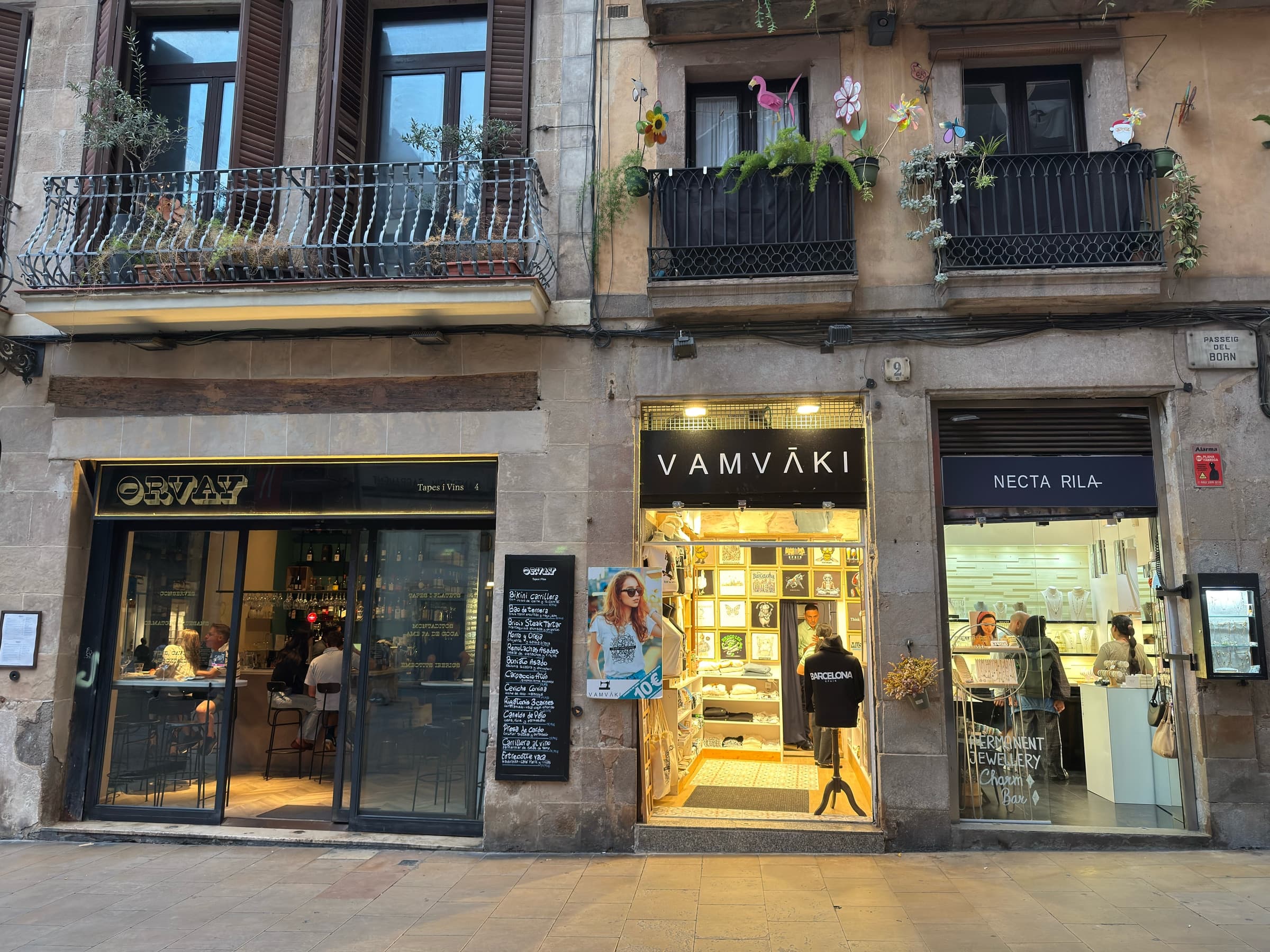
Between May and July 2026, we spoke in person with ten businesses in Barcelona and Santa Coloma de Gramenet. We included shops and hospitality businesses whose owners are directly involved in day-to-day operations. We spoke with people working alone, couples running a venue and people leading small teams.
The interviews were semi-structured: a shared guide to ask about practices, decisions and recent experiences, with room to follow what each person considered important. We looked for examples of things that had already happened: a delivery, a price change, a purchasing decision or a task still waiting.
- Healthy food
- Clothing and alterations
- Beauty and aesthetics
- Craft brewery with its own venues
- Loose detergents and cosmetics
- Specialist butcher
- Speciality coffee and brunch
- Local crafts and design
- Independent restaurant
- Coffee brand with its own shop
The first edition (opens another tab) brought together eight interviews. This report keeps its four themes and compares them with two later conversations: a restaurant and a coffee brand with its own shop. Separately, we add the perspective of a speciality coffee distributor.
This is a small sample, recruited mainly through trusted networks. Food and hospitality predominate. It helps us ask questions and recognise situations; it does not represent all local businesses or measure how many face each problem.
Before talking about difficulties
What a shop knows how to do.
The conversations revealed accumulated craft: recognising what someone wants, choosing a good supplier, recommending without pushing a sale and rebuilding after a difficult period. That knowledge has operational value. It sustains decisions and relationships.
A practical community also emerged. Other shopkeepers offer recommendations, help find solutions and create occasions for people to return to the neighbourhood. At a craft shop, the owners put it this way:
“We don't have competitors, we have colleagues.”
Craft and design shop · First edition (opens another tab)
Starting with these strengths changes the question: which parts of the work can be made easier so there is more room for craft and customer relationships?
Four themes to keep exploring
Where invisible work builds up.
The business relies on knowledge that is hard to share.
Prices, suppliers, customer preferences and exceptions often go through the person running the shop. Delegating a task doesn't always mean delegating the judgement needed to handle it. That concentration can make it hard to step away, grow or take over a business.
“It's all in my head. I don't have a system at all.”
Food shop · First edition (opens another tab)
In another conversation, a shop's new manager described prices the previous owner knew but had never recorded. Handing over the premises hadn't handed over all the knowledge needed to run them.
Question: what should be made visible so the work can be shared without losing the shop's own judgement?
Inventory and margin need a foundation you can trust.
Knowing roughly what's left may be enough to handle an urgent need. Buying, comparing costs or reviewing a price requires more: identifiable quantities and products, up-to-date costs and a way to check the data.
In several shops, that information was scattered across the point-of-sale system, spreadsheets, invoices, memory and physical checks. One person described discovering an outdated cost that had led them to sell below what they were paying. This was one account in an interview; we don't know how often it happens across the sector.
The craft shop offered a counterpoint: it already had its own system for collaborators to check sales and help decide how to display products. Each business started from a different place.
Question: what is the minimum information needed to trust a purchasing, pricing or restocking decision?
Coordinating suppliers means bringing scattered pieces together.
Orders by WhatsApp or phone, confirmations by email, documents arriving with deliveries and invoices checked later. Shops don't all use the same channels. At a loose-goods shop, for example, much of the supplier relationship happened through email and follow-up.
Checking a cost change, quantity or received product meant comparing information and finding time. A hospitality owner described a colleague who noticed a milk price increase months later: a second-hand account, not a direct observation of that purchase.
Orders, products and invoices
Time, context and checking
Buy, restock or review a price
Question: how do you get from available information to a useful decision without entering it all again?
A tool stays when it fits the real day.
A beauty salon described the work its booking app already saved. Other businesses used software but still needed to enter data, export it or bring it together by hand. Having tools and having time to make use of them were different things.
Price mattered. So did the initial effort, trust, available help and the system working when customers needed serving. Some invoicing questions became another pending decision: what to change, whom to ask and how to do it without disrupting the business.
Question: what work actually disappears, and what new work does the tool require?
The two later interviews
Starting and maintaining are work too.
A restaurant with tools, and still many manual tasks.
The restaurant already used a point-of-sale system, inventory tools and a booking system. Its manager knew the available options. Even so, they described updating inventory every day as tedious. Photographing invoices, watching costs and reconciling movements still demanded attention.
They were interested in ways to detect purchasing changes, but the cost of adding tools was a barrier. Some of their biggest concerns were physical: premises, energy and working conditions. The conversation reminds us to place technology within the business's full reality.
A café where the obstacle was finding time to begin.
Taking on administration after a change of partners, the manager of a coffee brand had to learn a role previously handled by someone else. They knew of appealing tools. One seemed too expensive; another required collecting past invoices before getting started.
Close customer relationships were a strength and also interrupted administrative work. To concentrate, they left the premises. Their plans included hiring human guidance, chosen for credibility, and growing through delegation.
These two conversations sharpen the picture: understanding the cost of maintaining a tool and the effort of getting it running matters alongside its features. Saving time can mean rest, delegation or expansion; not everyone wants the same thing.
An additional conversation · Outside the shop sample
The other side of the order.
We also spoke with a speciality coffee distributor working with roasters, including small businesses with their own shops. During a video call, they shared their WhatsApp inbox: orders, voice notes, technical sheets, deliveries and questions all lived in the same place.
An order could require listening to audio, interpreting the request and transferring it to a sheet or another system. They wanted to bring documentation and communication together to reduce repetitive tasks while keeping personal contact for important purchases.
This perspective helps explain coordination across the counter: information sent by a shop can become interpretation work for its supplier. The problem doesn't end when someone presses “send”.
There is a clear limit to this perspective. It is one person's experience at a different point in the chain, with their own customers and needs. Their views on small shops do not replace what those shops tell us. The two sides' interests may align in reducing work and diverge on other decisions.
What remains open
Listening also means leaving questions open.
These interviews reveal situations and possible directions for work. They cannot promise time savings, prove that a solution will improve margins or establish that anyone will adopt it. Positive reactions to an idea need to be read differently from practices that already existed before it was discussed.
- What information is reliable enough to decide, and who keeps it up to date?
- What help does a shop need to get started without turning change into another pending project?
- What can be delegated, and what judgement does the person running the business want to keep?
- How does the experience change after weeks of use, when exceptions appear?
- What does improvement mean to each person: more control, more time, stability or growth?
Continuing to listen means looking for cases that confirm, contradict or complicate this picture. And observing how these tasks are handled in practice, focusing on what changes for the people doing them.
Method and sources.
- Sample
- Ten in-person, semi-structured business interviews, including owner-managed hospitality businesses. One additional video conversation with a distributor, outside that count.
- Period and location
- May–July 2026. Barcelona and Santa Coloma de Gramenet for the business interviews.
- Selection and limits
- Contacts through trusted networks and food and hospitality businesses predominate. A small qualitative sample, without statistical representation. Direct accounts, second-hand experiences and interpretation are distinguished.
- How we read the material
- Questions focused on practices and experiences before possible solutions. In one conversation, the idea was introduced at the end; those reactions are not used as evidence of demand. This edition keeps the initial themes and adds nuance from the two later interviews and the distributor, without turning them into percentages or consensus.
- Identity and editing
- Participants are described by business type. The first edition's two quotations retain anonymous attribution. New examples are presented as paraphrases. Private conversation records are not published here. Quotations have been translated from Spanish for this edition.
- AI support
- AI helped organise and edit the material. Interpretation, claim checking and editorial responsibility remain human.
This edition expands the original A pie de mostrador report (opens another tab), which covered the first eight interviews. The two later conversations and the distributor conversation have been checked against their research records.